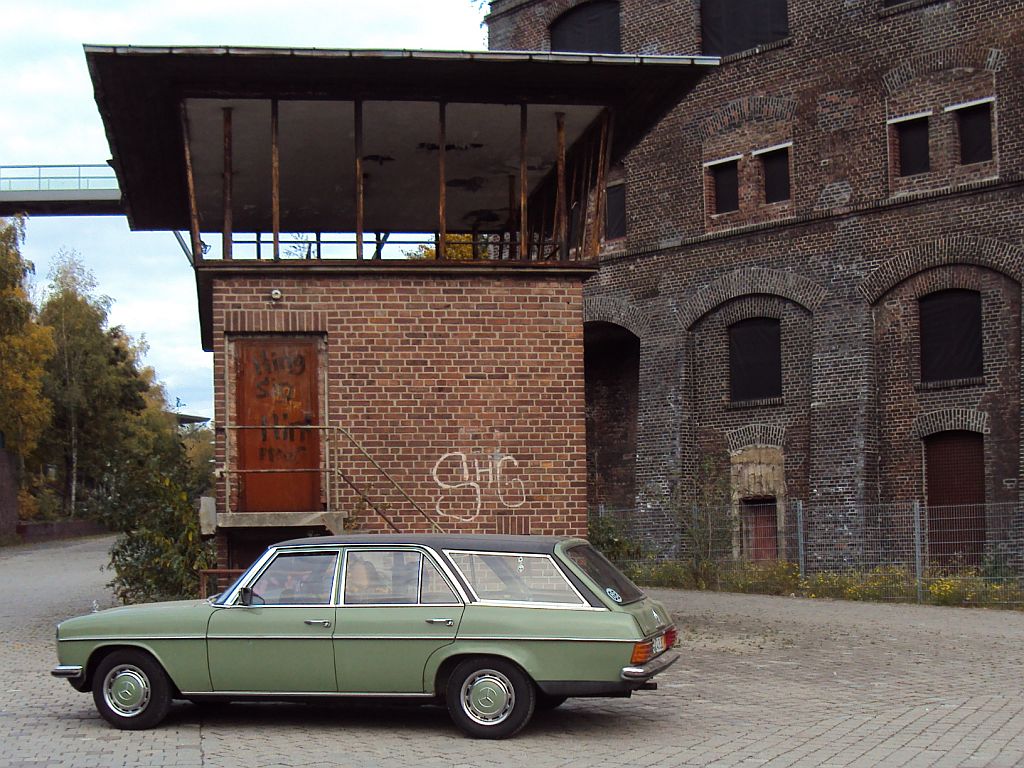
Sunday, 5 May 2024

Wiederbelebung

Der grüne Crayford /8 ist tatsächlich seit 2011 nicht mehr gefahren. Das ist 13 Jahre her.

Er steht in meiner Halle und wundert sich. Die böse Glosse von Martin Buckley über fehlgeleitete Menschen, die ihre Oldtimersammlung in schlecht isolierten Hallen verrotten lassen die wochenlang immer am Taupunkt entlang Feuchtgkeit absondern, die ist mir wohl bekannt. Der grüne Crayford /8 stand in einer großen trockenen Halle und hat dort Jahrzehnte ertragen.

Aber wir müssen weiter. Also schauen wir mal, wie es aussieht.

Draussen sieht es staubig aus. Das ist aber nicht schlimm.

Im Tank sieht es nicht staubig aus, eher verrostet. Das ist schon schlimm. Also raus mit dem Tank, was mit altem Sprit nicht lustig ist. Gleichzeitig ölen wir die Zylinder durch die Zündkerzenbohrungen und drehen den Motor leicht durch, kein Problem.

Und dann? Dann zieht der grüne Crayford /8 in eine neue Garage. Meine Garage, aber leider keine gute Garage. Besonders trocken ist sie nicht, aber wenn man keine Wahl hat. Er wird hier zwei Jahre bleiben, dann retten wir ihn.

Saturday, 27 April 2013

We are still alive

I am very sorry that silence has fallen upon the green Crayford /8. Lots and lots has indeed happened.

At the end of 2012, there was a fabulous Crayford Convertible Car Club X-mas dinner at Westerham, with the former director of Crayford signing his new book on the occasion of 50 years of Crayford. It was a huge pleasure to meet David McMullan and experience first-hand what a great engineer and man he is. The meeting at a new pub right on the green at Westerham was spot-on and drifted from a great lunch slowly into a boozy evening (for me, that is).

While I showed a picture on the blog with some spare parts late in 2012, you have shurely recognised them to be the gasket of the automatic transmission oil-pan and two new hoses for the automatic transmission oil cooler that is incorporated into the radiator. Those hoses were changed easily. The oil change in the transmission, with a new filter and a new gasket, was more troublesome. In fact, it had been long long ago since the automatic transmission had been attended to and one of the four bolts that secure the oil pan to the casing snapped off. A very unpleasent situation, as the remains of the snapped-off  bolt could not be extraced, not even with the generous application of heat. In the end, we drilled it out and cut a new thread into the casing. As it only had to withstand 8 Nm of torque, the whole operation proved - more or less - successful. New oil (Fuchs Titan 3000) and filter (MANN) are in and the car changes gears lovingly.

Next on the map is the huge fuel consumption we experienced (ahem) 2009 on the long trip to the south of germany. This is a matter of cleaning and re-adjusting the carburettors. I will attend to them very soon because there are plans to re-create said trip this year, for the 2013 Ornbau gathering in the mid of may. Stay tuned.

Friday, 17 August 2012

Time for some attention

Imagine what will happen today!


Saturday, 29 October 2011

Endlich wieder Meilen machen

Zwar hätte es meine Gesundheit so richtig heute nicht zugelassen, aber es war nun mal alles vorbereitet und dann musste es halt sein.

Eine Runde mit dem grünen Crayford Kombi /8. Und das nicht nur zweimal über das Hallengelände sondern so richtig raus. Wie früher. Wie zuletzt 2009, bei der großen Reise nach Süddeutschland.

Nun, ganz so weit sind wir nicht gekommen. Erstmal was essen.


Und dann eine kleine Runde zur Jahrhunderthalle. Vorsichtiges Ertasten der Umgebung.


Das Auto rappelt und klappert, das Getriebe will nicht so recht schalten und hätte wohl gerne ein wenig Öl und einen neuen Filter, die Federung hängt auf Halbmast und der Motor klingt wie ein alter Diesel. Alles egal. Der Crayford Kombi /8 fährt. Mit mir.


Bester Tag seit Langem.

Monday, 18 October 2010

Friday, 3 September 2010

Breaker points

After having set the valve clearances some weeks ago, I continued the little tune-up today with new breaker points. They had been delivered to my Mercedes-Benz agent who was surprised to see such an item again after a very long time. Then I visited the local BOSCH agency and obtained some special super-sticky grease for the distributor shaft.

At the car, the distributor cap and rotor were easily off, the distributor shaft cleaned and the new breaker points installed, with the gap pre-set to 0.4 mm when open with the help of a feeler gauge. The most difficult thing was to turn the distributor shaft for the contacts to be open. The car being automatic, there was no use in pushing it to and fro. The remedy was to simple slacken the distributor fastener and turning the whole distributor around its shaft. The ignition timing has to be re-set anyway. After everything was put togeher again, I fine-tuned the dwell angle by carefully moving the breaker points in the distributor and finally obtained the perfect 41-42 degrees.

After every little part of the tune-up, the engine runs smoother and the revs when the engine is idling are rising and rising. Obviously the car enjoys the care that is being taken.

Saturday, 21 August 2010

Heavily sidetracked

As announced yesterday, I planned to start celebrating the Crayfords birthday today with a few new parts. The actual status of the engine is: runs well, starts well, does not go beyond 120 km/h and drinks fuel at a very heavy rate.

As engine issues are always due to the carburettors, and carburettor issues are always ignition issues, and ignition issues are always just wrong valve clearances, I started with the latter. Re-set the valve clearances. Should not take more than an hour.


As if! Firstly, this car has twelve valves compared to my other cars eight. It then turned out to be a very long time ago that some garage checked or - god forbid - adjusted the valve clearances. The first adjusting nut was completely locked up. The remedy was to disasseble the rocker arm and then turn the adjusting nut with a suitable socket, instead of using the adjustment tool. The springs that secure the rocker arms are surprisingly difficult to reinstall. Now where do I know that from?


However, I adjusted my way through the twelve valves, the clearances of which were much to small. All of them. With disassembly (the viscous coupling has to come out to turn the crankshaft) and re-assembly this easy task took six hours. On the way, I also correctly set up the cold start unit (which had been renewed a few years ago) of the rear carburettor.


And finally a short test drive was undertaken and everything felt very well indeed.

Friday, 20 August 2010

Happy birthday

The green Crayford /8 estate turned 37 today. It made it through all those years and is now the only one left on the road, with only one remaining brother that is somewhat alive. What an achievement! We wish it all the best and a lot of happy years to come. For celebration, lets see the car back at home, where it was born, at the Crayford factory:


I bought it a number of birthday presents (a new distributor cap and rotor and new breaker points) and am planning for new ignition leads and then a major overhaul of the two Zenith carburettors. It is about time that we get going again.

Saturday, 17 July 2010

We have finally succeeded

The title phrase was originally (well, perhaps not for the first time) coined by a group of 70s New York graffiti artists that did a "whole train" - paint ten subway cars in one night with a more or less continuous theme. I kind of feel like I did this tonight. But I finally succeeded - the green Crayford /8 estate is completed again and runs well.

Well, assembly is more or less the opposite of disassembly. So I put the car together again: refill the power steering system with fresh oil and fit a new filter, mount an almost new BOSCH alternator instead of the questionable (but very fashionable) LUCAS item, tidy up the wiring that connects to the alternator, complete all the balancer/pulley/belt stuff again and finally fit a radiator that actually stays at its designated place instead of moving around, because of the formerly missing and now introduced rubber guidings at both sides.

And the result? The radiator fits perfectly and the fan does not touch the radiator any more - finally. The new seals are holding back the oils fine and the car drives again. Did a little test drive. Very well. Dirty fingernails: plenty. Problems fixed: plenty. Lets go.

Saturday, 10 July 2010

Running very hot

Not the car, me! 33 degrees centigrade even at 8 pm. Consequently, work on the green Crayford /8 estate was very slow today, but nevertheless steady. Relaxing on my sofa with a pint of Old Speckled Hen in hand, everything is now fine again but in the workshop it was hot!

However, when I arrived in the morning the car presented itself still with the front mainly in parts. I pulled a chair to the car and started work. First task was to remove the power steering pump to clean it and replace the seal ring on the main shaft of the pump. To access the bolts to remove the pump you first have to remove the pulley. You need a special puller for that - a puller I did not own. The puller I eventually scrounged did only barely fit. With a combination of puller, parts from a spring tensioner, an hour of patience and finally a big hammer the pulley was off at last. Because I decided to remove the power steering pump completely, I unscrewed the hoses (one of which did not come off easily and needed a few seconds with a torch - which again I had to scrounge) and then replaced said seal ring with the pump safely on the workbench without much hurry. Then the pump went into the car again. All is well.


Next, in went the other seal ring, the one on the crankshaft. I had already removed the chromed ring on the crankshaft on which the inner lip of this seal ring runs on. The chromed ring was polished and installed again the other way around. After the new seal was carefully hammered in place, I started to reassemble the crankshaft balancer etc. Easy going. The temperatures had meanwile risen to their afternoon heights and I retired.

Saturday, 12 June 2010

Work commences...again

During the last week or two, I had a few thoughts about the future of the green Crayford /8 estate. The overall objective is to have the car on the road, at least a few times a year, to enjoy it and to show it at a club gathering or a similar event. The main problem is the german TUEV (the MOT equivalent) who is not happy about the condition of the bodywork of the car. The possible solutions were found as follows: 1. have the car restored to top condition (I cannot do this myself) 2. have the car welded up crudely so that it somehow passes the TUEV test or 3. enjoy the car as it is with a couple of 5-day temporary number plates a year (no TUEV approval is needed and you can drive virtually anything on them, hard to believe in Germany).

I had a great welder in to discuss solution no. 1 but did not like his attitude. There is another guy in Germany that is absolutely unbeatable when restoring /8, and I will talk to him eventually. This will be VERY costly, anyway. Solution no. 2 was out easily, I will not destroy this car. After some thinking, solution no. 3 was chosen as a temporary remedy for the next few years or so. I will try and find out whether I can live with it or not. Its main advantage is that the green Crayford /8 estate will be on the road again, soon!

So, work commenced again today. After being laid up for almost a year, the car started easily and I drove it onto my workshop lift and got to work. First thing was to remove the radiator - again, and I finally found the reason why the fan touched its housing all the time. The radiator was missing a rubber running down its side that secures its position relative to the body. This time, I removed the radiator together with the oil cooler, because otherwise its brackets would finally be destroyed during dismantly. This meant unscrewing the oil feed lines that were last touched almost 40 years ago, but everything went very fine. The radiator was out and cleaned, as was the fan shroud.

This was only foreplay, the main reason to attack the car was the huge oil leak from the front of the engine, and I suspected the front crankshaft oil seal was the reason for this. With the radiator out of the car, getting to the seal is not too difficult. You simply dismantle the car, beginning at the front. Both alternator and power steering pump had to come off to remove the respective belts, and both protested. A bolt securing the alternator was rusted solid in the alternator body (someone tried to remove it a long time ago and failed, but managed to damage the tensioning mechanism), and the power steering pump simply refused to surrender. Eventually, I won.

With the belts taken off, you remove the pulley on the crankshaft and then attack the balancer that is mounted to the crankshaft with a very sturdy bolt. Out came the impact wrench and on went the 1000 litre 8 bar air compressor in the workshop. The next half an hour was rather boring and very noisy, but finally the bolt gave up. Thirty minutes of continous attack! Next, I removed the balancer using a specially made extractor and collapsed.


The workshop looked a bit clattered by then, it was like in the good old times, a /8 on the workshop lift, tools all around and the scent of oil in the air. I simply love it. This is so rewarding!

Saturday, 25 July 2009

Time for a refill

During the preparation for the big trip to the south of Germany a few weeks earlier, the new aftermarket radiator did not entirely convince me: it did not fit properly and the fan hit the air ducting because of the poor fit. In the meantime, I managed to acquire an almost new original Mercedes-Benz/Behr radiator that had only been in use for a few months. So it was time to change radiators. Out with the old one. In with the new one.


This is always a little bit of work. Drain coolant. Disconnect coolant hoses. Disconnect hoses for the oil cooler of the automatic transmission. Part radiator from the oil cooler. Remove radiator. Then assemble accordingly.

While the whole lot was in pieces again, I decided to fit a new viscous coupling because the old one had lost its oil filling and looked like this:


and the new one had been delivered to my house from an eBay seller for the precise sum of 1 Euro a few days earlier:


Disassembly/assembly is so easy there is no need to describe it. That done, the car was completed with the "new" radiator in only a few minutes. After all the piping had been connected, it was time to refill the coolant. This was done in true british manner.


The green stuff is coolant, not "Old Speckled Hen"... Tastes differently, too. So finally, a radiator that fits correctly.

Friday, 12 June 2009

A sad day

Today my insurance cover run out. No more driving the Crayford. A sad day.

I am still in the process of deciding how to continue with this fantastic car. Instead of a full restoration that might take it off the road for years, I intend to get the worst rust spots welded up (more or less crudely) and have the car TUeVed. So that I can take it for a drive if the weather is fine, like Rory did. And on a day like today, I would love to do that. Instead I had to attend Autobingo with my red /8.


Could be worse. But the Crayford would have enjoyed it.

Saturday, 30 May 2009

Ornbau - the big gathering

I set of at 6.30 am (see yesterdays posting to calculate how much sleep I got), drove the car out of my garage, closed the garage door behind me, turned right at the first crossroads and drove right away into the arms of an police control. Well, not quite, as the car decided to stall a few meters in front of them. What a start. But they only wanted to know whether I drank lots of booze yesterday or today, and I wholeheartedly answered "NO". The police officer stepped to the right (the right) side of the car, but he approached me in german. Kind of an half-hearted attempt. But very friendly, although being asked to show the car documents I answered (less wholeheartedly this time) "no". Well, I got away with it.

After collecting my co-travellers on the way, we set of for the big Mercedes-Benz club gathering at Ornbau, located in the most beautiful southern region of Franconia. As you can see, there was no time to visit the hairdresser.


Spirits were high, weather was best, the car behaved - almost, coming to a stop when we were nearly there, with fuel starvation. Filling up the tank helped. Calculating the fuel consumption (12 mpg) did not help. Readiness to travel restored. Oil level checked. Drops lots of it.


We then resumed our travel without problems and drove right into the huge gathering, with hundreds of cars and thousands of visitors.


The car got parked next to another Crayford, no stroke-eight of course but a W116 that was somewhat "improved" during its restoration. A very interesting car, and putting two Mercedes Crayfords together should not have taken place for some time.

The funny thing is, everybody has got an opinion about the Crayford stroke-eight. And although everybody got the same opinion about it, everybody needs to tell it to me. As if I never saw my own car before. And yes, I KNOW that the roofline is not perfect.

But what a wonderful way to spend a wonderful day. We talked, bought parts and in any way socialised for the rest of the day. Then Michael, one of my co-travellers, asked for the car keys and I gave them to him. A few minutes later, he appeared with the car right in the middle of the meeting and drove it into the club headquarter, where TUeV checks are carried out during the day. And then it all started.


The TUeV officer, a member of the Mercedes club, gave us very helpful advice on what to do so that the car will gain TUeV approval. From the technical side, there was not much to nag about, brake hoses at the rear and one or two rubber buffers. Examining the structure, there were more severe problems, and we were explained in detail what needs to be welded and what can remain like it is. We also got valuable advice about the procedure to acquire the german historic number plate, where special examinations and tests are carried out.

After all the good news, we put the car to rest and started to party in a serious way. A stroke-eight taxi took me to my hotel late at night. One of the things I still remember.

Friday, 29 May 2009

More work

With the intention to take the green Crayford /8 to a big Mercedes-Benz gathering tomorrow, I set to work at about 2 pm. The first thing to re-assemble was the propshaft, featuring a new rubber boot and a new bearing (an of-the-shelf over-the-counter model bought from a bearing company for less than Mercedes asks for). The rubber boot is quite expensive at about 45 Euros.


The propshaft, well marked before disassembly of course and cleaned a bit afterwards, went into the car almost by itself. No problems here whatsoever. New self-locking nuts, of course. The flexible joint discs at the front and at the rear were checked and proved to be OK. Very rewarding.

Next on the list was the rear exhaust: pick up new part from workshop floor, hold it into direction of car, fit it. Easy.

The fuel tank got a new seal for its filter element and was also easily refitted. New fuel hoses and clips at the same time, of course. And the missing plastic locking cap for the boot floor (where the wires to the fuel sender unit pass the floor) was added, not too expensive a part at about 1,50 Euro.

Our prayers were then obeyed and the bleeding valves of all the brake calipers opened without ripping off, although they were quite rusty. So we bled the brakes, cleaning the brake fluid reservoir on the way. One of the three caps of the reservoir proved a bit leaky and a little spray of brake fluid eat itself into the paintwork of the engine bay. Most was rinsed off in time. But I forgot to rinse the left front wing. No idea how the brake fluid got there in the first place. Nice row of dots though.

I continued with little cosmetic improvements, like mounting new bonnet buffers.


Meanwhile it was time for dinner, and afterwards Felix started to clean the interior of the car out of pure kindness. I tackled another task, bigger this time. The leaky radiator.


This started well, with the old radiator easily removed (it includes an oil cooler for the automatic transmission and is mounted together with the oil cooler for the engine oil, so some wrenching was on order). The new radiator fitted in with more difficulties, as some details and the mountings for the fan shroud were quite different. After long hours it proved impossible to fit the fan shroud without the fan touching it, making loud noises. The resolution was to move the radiator forwards as far as possible, using a lot of force (it should not move anyway, so another problem) and locate it there with cable ties. 1 am by now. A quick fix but not a satisfying one.

Work was not finished and I installed a new-old Blaupunkt radio (with FM) so that we can listen to some radio/iPod during our trip tomorrow. Well, today. I finally took the car to my house, arriving there at about 2.30 am. A long day, a short night.

Sunday, 24 May 2009

Lots of work

and no photographs.

Yesterday was a recreational day after the little get-together on Friday, but today work continued on the green Crayford.

During the little outing on Friday the propeller shaft became very noisy, so today Daniel and I dismantled more or less the complete underside of the car to remove the propshaft. We finally extracted it from the car and disassembled it on my workbench. The bearing was fine, the rubber boot was completely shot. Unfortunately, you have to destroy the bearing (or at least damage it severely) to remove the rubber boot. We succeeded in doing that. New parts to be bought tomorrow.

Then we removed the rear silencer that had parted from its tube. The middle silencer is fine, though.

When we collected the car from Britain, Rory told me not to fill the fuel tank completely because he never did and he did not know whether it was rusted through on the top. So we drained (mega-yuk, I hate working on gasoline engined cars) and removed the fuel tank to find it in serviceable condition. A good clean confirmed that it is rusty on the outside but fine on the inside. I will change the seals for the fuel sender unit and the fuel drain plug, renew the hoses and simply put it back onto the car.

As I found the radiator to be leaky a few days ago, I ordered a new one but it has not been delivered yet. So I prepared the old radiator for removal, giving the connections for the automatic transmission oil cooler a good spray of WD40. The engine oil cooler can be parted from the radiator and will remain in the car. Daniel suggested not to remove the old radiator until the new one sits in my workshop, and I followed this wise suggestion. The car would be rendered completely stationary if something broke during removal of the old radiator.

Then I decided to continue with low-profile cosmetic improvements: replace the faulty switch for the rear interior light operated by the left rear door (the new switch looks very differently and will be exchanged for an originally-looking old part as soon as possible), removing the rubber from the rear bumper (finding the chromed bumper severely rusted on the left part and fine on the right part), clean away the rust and reassemble the rubber for a much-improved look, and firmly attach the "250" badge on the completely rusted-through bootlid (an operation during which the bootlid disintegrated in this area).

We began to clean the engine, which is very oily on the left side, but did not detect the origin of the oil dripping to the ground from the engine. The same goes for the fuel smell, it may simply originate from the shot rear silencer (engine running rich) or from the fuel lines at the fuel tank, which I will renew. The fuel hoses in the engine compartment are more or less new already.

So much for today. Collecting parts tomorrow.

Friday, 22 May 2009

One patient and many doctors

A few friends came round to my workshop today, to celebrate the near-mystical appearance of the Crayford /8 and its faultless journey from Britain. A little drive with four on board was on order.


It is always a good idea to have competent Mercedes-Benz personnel with you.


Afterwards we fired up the barbeque and I did the little celebration with the Crayford /8 that I prepared when we brought it over from Britain - having a very nice pint of british real ale. Old Speckled Hen, if you insist to know.

Now the odds were against me: I wanted to celebrate, the crew wanted to inspect the car. After we chased away a north-african taxi, the Crayford changed from a place on the ground floor to the heights of my workshop hoist for the first time.


I then stopped taking photographs. But what happended next was like this (from "Asterix in Switzerland").


There was some (well, a lot of) rust, but not unexpectedly so. There was some oil that should better be on the inside of the engine. There was some water that should better keep itself in the radiator instead of dripping out of it. And there was a lot of noise from the silencer that had parted from its tube on the ferry. A new one is already lined up in my workshop.

And during the aforementioned small drive, the center ball bearing on the propeller shaft more or less desintegrated... More work to do.

Monday, 18 May 2009

Giving it a good clean

Arriving at my workshop.


New tires on older but very serviceable /8 rims.


Jacking the car up for a good clean.


Front left wheelarch.


View from the engine bay. Left inner wing rusted off from the footwell.


Rear left wheelarch. Rusted through to the front and at the bottom.


Left inner/outer rear wing. Not much left there.


Front right wheelarch before cleaning. Rusted through to the footwell, too.


Front right wheelarch after cleaning.


Rear right wheelarch. No metal left at the bottom.


Visit from a differently coloured friend.


First small repairs: adding the missing rubber grommet at the left spring for the bonnet (see inset).


Next I removed the period Blaupunkt radio (that only plays LW and MW), the switch for the (now missing) electric antenna and the rotary knob for moving the radio sound to the front or rear. A similar radio that also plays FM is already on the shelf and will be installed when a missing rubber grommet is obtained. In the meantime, the original blanking plate for the radio, featuring the "250" script and found in the glovebox, found its way there.


The left red knob is for the hazard flasher and the right white knob is operating the heated rear window. What the black knob in between is responsible for was unclear to Rory and also to me until I examined the connections in more detail. The knob is connected to original Mercedes-Benz wiring. And the car features an interior light in the back that is normally operated by a switch in the dashboard. This car being a RHD version, the place for this switch is taken up by the handbrake. So Mercedes-Benz moved the switch for the rear interior light into the center console on RHD cars. After I added a small bulb into the rear interior lightning unit, there was light and the switch did what it was intended to - turn the light off and on. Success.